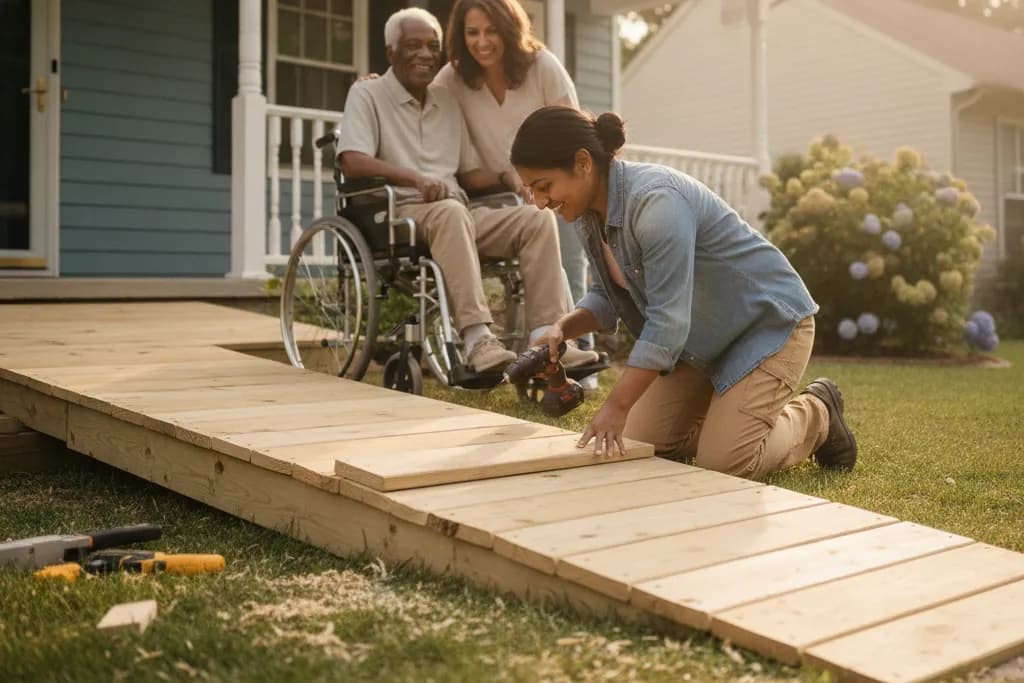
The stairs are the problem. Your dad can still get around the house with his walker, but those three front steps have become a real barrier — and the bathtub he's climbed into for forty years now feels like the most dangerous place in the house. A ramp and a walk-in shower would let him stay home safely. A contractor quoted you thousands of dollars. So you start searching: does Virginia Medicaid pay for home modifications?
The short answer is yes — but not through regular Medicaid coverage. It comes through a Medicaid waiver, it has firm dollar limits, and it has to be approved before anyone picks up a hammer. Here is exactly how it works in Virginia, what's covered, what isn't, and what to do if your loved one isn't on a waiver yet.
Yes — through the CCC Plus Waiver, not standard Medicaid
Standard Virginia Medicaid covers doctor visits, hospital stays, and durable medical equipment. It does not, on its own, pay to remodel a bathroom. Home modifications are a waiver service: they're available to people enrolled in Virginia's CCC Plus Waiver, the home and community-based waiver for older adults, people with physical disabilities, and people who are chronically ill or severely impaired and would otherwise need nursing facility care.
The Virginia Department of Medical Assistance Services (DMAS) lists the waiver's covered services as personal care, respite, private duty nursing, adult day health care, services facilitation, transition services, and three that matter for a home that no longer fits its owner: Environmental Modifications (EM), Assistive Technology (AT), and a Personal Emergency Response System (PERS). You can see the official service list on the DMAS CCC Plus Waiver page.
The waiver is administered today through Cardinal Care managed care, so in practice the person who helps you request a modification is the care coordinator at your loved one's Medicaid health plan, working with the services facilitator or care team.
Environmental Modifications: what Virginia Medicaid will pay for
Environmental Modifications are physical changes to a home — or to a vehicle — that are needed for someone's health, safety, and welfare, and that give a direct medical benefit. In practice that means changes like:
- A wheelchair ramp or a zero-step entrance
- Grab bars and bathroom modifications that make bathing and toileting safe
- Widening doorways for wheelchair or walker access
- Modifications to the individual's primary vehicle
Two numbers govern everything. Under the Virginia Administrative Code section that defines waiver services, 12VAC30-120-924, the maximum funded expenditure for environmental modifications is $5,000 per individual per calendar year — that's items and labor combined. The limit follows the person, not the waiver, so switching waivers mid-year doesn't reset it, and unused dollars do not carry over into the next year.
The regulation also requires the work be done in the least expensive manner that meets the person's need, on the individual's primary residence (or primary vehicle), and in line with state and local building codes.
What is not covered
This is where families are most often surprised. Environmental Modifications are not a home-improvement fund. The regulation specifically excludes adaptations that provide general utility without direct medical benefit — carpeting, flooring, roof repairs, and central air conditioning are named examples — along with routine home maintenance, leisure and recreational items, and any change that increases the home's square footage. If a modification would be nice but isn't medically necessary, expect a denial.
If your loved one rents
Renting doesn't disqualify you. Modifications to a rental do, however, require the prior written approval of the property owner. Get that conversation started early — a landlord's signature is often the longest step in the whole process.
Assistive Technology: a separate $5,000
Assistive Technology is the equipment side of the same idea — devices that help someone communicate, move, or manage daily tasks more independently. It carries its own $5,000 per calendar year maximum, separate from the modification budget, with a few rules worth knowing:
- Under the CCC Plus Waiver, AT is not available to individuals younger than 21.
- Equipment must be purchased, not rented.
- Every AT request needs an independent professional consultation from someone knowledgeable about the item — and that consultation cannot be done by the company supplying the equipment.
- Items for the convenience of a caregiver, or for recreation, education, or diversion, are excluded.
That conflict-of-interest rule runs through environmental modifications too: a provider that supplies the modification is barred from performing the assessment or writing the specifications for it. Expect a therapist, physician, or independent consultant — not the contractor — to document the need.
Don't overlook PERS (the medical alert button)
A personal emergency response system is often the cheapest safety upgrade in the house, and it's a covered waiver service — but it has narrow rules. Under 12VAC30-120-924, PERS is limited to waiver members age 14 and older who live alone or are alone for significant parts of the day, and it's only provided alongside personal care, respite, or adult day health care. It's authorized only when no other competent adult is in the home to call for help. The regulation also excludes individuals who have a cognitive impairment as the rule defines it — so if memory loss is part of the picture, ask the care coordinator what the safer alternative is.
How a ramp actually gets approved: the order of operations
- Get enrolled in the waiver first. Modifications flow from waiver membership, which starts with a Medicaid application and the Virginia Medicaid LTSS screening that establishes the level-of-care need.
- Raise it with the care coordinator. Tell your loved one's Medicaid health plan care coordinator (and services facilitator, if you use consumer-directed care) what problem you're trying to solve — "he can't get out of the house," not "we want a ramp."
- Get the independent assessment. A physician, occupational or physical therapist, or qualified consultant documents the medical need and the specifications.
- Get bids from a Medicaid-enrolled provider. The work must be done by an enrolled environmental modification provider — not whoever is cheapest on a neighborhood app.
- Wait for service authorization. Both AT and EM require pre-authorization by DMAS, its service authorization contractor, or the managed care plan before the service is delivered. This is the step families get burned on: work started before approval generally will not be reimbursed.
- Keep the paperwork. Repairs to modifications that Medicaid already paid for can be covered, so hold onto the authorization and invoices.
A note for families on a developmental disability waiver
If your family member is on one of Virginia's DD waivers — Building Independence, Family and Individual Supports, or Community Living — the budgets are structured differently. Effective September 1, 2025, DMAS combined Assistive Technology and Electronic Home-Based Supports into a shared $10,000 annual limit on those waivers, while environmental modifications stayed separate at $5,000 per calendar year. Ask the support coordinator how the current year's budget is being tracked before planning any purchase.
If you're not on a waiver yet: other Virginia options
Veterans
The VA's Home Improvements and Structural Alterations (HISA) benefit pays for medically necessary modifications to a veteran's primary residence — entrances and exits, roll-in showers, accessible sinks and counters, permanent ramping. According to the VA's HISA program page, the lifetime benefit is up to $6,800 for veterans with a service-connected disability (or a non-service-connected disability where the veteran has a 50% or higher service-connected rating) and up to $2,000 for other non-service-connected disabilities. Applications need a VA physician's prescription, VA Form 10-0103, cost estimates, photos, and the owner's authorization if the veteran rents. Decking, hot tubs, portable ramps, stair glides, and routine repairs are excluded. If a veteran in your family may also need help at home, our overview of veterans' home care benefits in Virginia walks through how these programs fit together.
The Livable Home Tax Credit
Virginia's Department of Housing and Community Development runs a Livable Home Tax Credit for accessibility retrofits: up to 50% of the cost of retrofitting an existing home, not to exceed $6,500, with unused credit carried forward up to seven years. It's a state income tax credit, not a grant — you pay first and claim later — and because the annual pool is capped, credits are prorated if applications exceed the allocation. Keep before-and-after photos, contracts, invoices, and canceled checks; the application requires them.
What Medicare will and won't do
Medicare is not a home modification program. It covers durable medical equipment — walkers, wheelchairs, hospital beds — when a doctor certifies medical necessity, but it does not pay to install grab bars, build ramps, or remodel a bathroom. Families who assume otherwise lose months. Your local Area Agency on Aging is a better next call; some administer small home repair or safety programs funded through the Older Americans Act.
Modifications work best alongside a safety plan
A ramp solves an entrance. It doesn't solve a 2 a.m. trip to the bathroom. The families who succeed at aging in place pair physical changes with the rest of the picture — lighting, clutter, footwear, medication timing, and hands-on help at the risky hours. Our guide to fall prevention for seniors in Northern Virginia covers the low-cost changes that often matter more than the expensive ones.
A Virginia note
Waiver rules, dollar limits, and covered service definitions are set by DMAS and can change. The figures above come from the Virginia Administrative Code and official DMAS and VA sources current at the time of writing. This information is for general guidance only and isn't legal or medical advice — program rules and figures change, so confirm current details with the official source or our team before you sign a contract or start work.
How Godaelli helps
Godaelli Health Care Services is a Northern Virginia home care agency that works with CCC Plus Waiver families every day. We can't build your ramp — that's a job for an enrolled modification provider — but we can help you get to the point where one gets approved: understanding whether your loved one qualifies for the waiver, preparing for the LTSS screening, and putting personal care support in place so the hours between modifications are covered. When a family member wants to be the paid caregiver, we help set that up through consumer-directed care.
If you're staring at a contractor's quote and wondering whether Virginia Medicaid will help, reach out to our team. Call 703-870-0738 or email care@godaellihomecare.com, and we'll walk you through where your family stands and what to ask for next.
Frequently Asked Questions
- Does Virginia Medicaid pay for a wheelchair ramp?
- Yes, for people enrolled in the CCC Plus Waiver. Ramps fall under Environmental Modifications, a covered waiver service for changes that are medically necessary for the person's health, safety, and welfare. Standard Medicaid coverage on its own does not pay for home modifications.
- How much will Virginia Medicaid pay for home modifications?
- Under the Virginia Administrative Code, environmental modifications are capped at $5,000 per individual per calendar year, covering items and labor combined. Assistive technology has its own separate $5,000 annual limit on the CCC Plus Waiver. Confirm current amounts with DMAS or your care coordinator, since the rules can change.
- Does the $5,000 roll over if we don't use it?
- No. The limit is per calendar year and unused funds do not carry over into the next year. It also follows the individual rather than the waiver, so changing waivers mid-year does not reset it.
- Can we get modifications if my parent rents their home?
- Yes, but modifications to a rental property require the prior written approval of the property owner. Ask the landlord early — getting that approval is often the slowest step.
- Can I hire my own contractor to build the ramp?
- The work has to be done by a Medicaid-enrolled environmental modification provider and authorized in advance by DMAS, its service authorization contractor, or the Medicaid health plan. Work started before authorization generally will not be reimbursed. The provider that does the work also cannot be the one who performs the assessment or writes the specifications.
- Does Medicare pay for grab bars or a walk-in shower?
- No. Medicare covers durable medical equipment such as walkers, wheelchairs, and hospital beds when a doctor certifies medical necessity, but it does not pay for home modifications like grab bars, ramps, or bathroom remodels.
- What if the modification costs more than the annual limit?
- Families often phase work across calendar years, or combine the waiver benefit with other help such as the VA's HISA grant for eligible veterans, Virginia's Livable Home Tax Credit, or programs offered through the local Area Agency on Aging.
- Do we have to be on the waiver before asking about modifications?
- Yes. Environmental modifications and assistive technology are waiver services, so the first step is Medicaid eligibility plus the LTSS screening that establishes the level-of-care need. Once enrolled, raise the request with the care coordinator at the Medicaid health plan.

.jpg&w=3840&q=75&dpl=dpl_6fdbNDk1G2ZVRfqb1yRvU4WzLzuD)